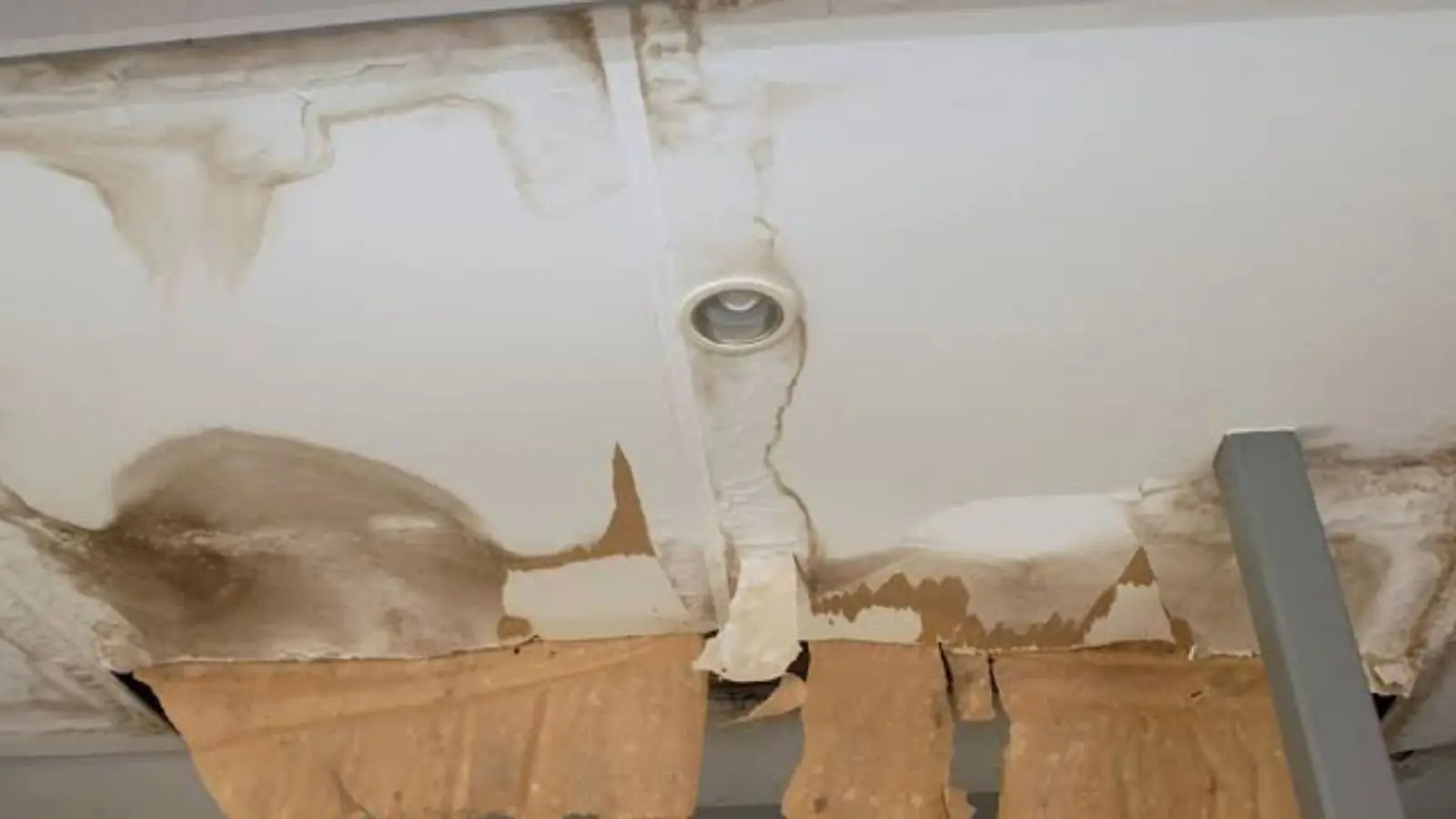
A Ceiling Stain Is the End of the Story, Not the Start
When a ceiling shows a brown ring, the water has already traveled. It came from somewhere above, moved along framing or pipes, and showed up where it could. The stain is where the water left the structure, not necessarily where it entered.
That is why a repair that starts with paint often fails. The first job is to stop the source and learn how much of the ceiling and the cavity above it is wet.
Stop and Look Before You Touch
Keep people out
A sagging ceiling holds water and can fail without warning. Stay out of the room.
Cut power if needed
Lights and fans in a wet ceiling are an electrical hazard. Switch off the circuit if you can reach the panel safely.
Stop the source
Shut off water to the unit above, the bathroom or the fixture you suspect.
Catch the drip
Put a bucket or tub under a drip and move belongings away.
Photograph everything
Capture the stain, the room and any water on the floor.
Call for help if it is sagging
A bulging ceiling often needs controlled draining by a crew.
What the Ceiling Is Telling You
| What you see | Likely meaning | Usual response |
|---|---|---|
| Light yellow or tan ring, dry to the touch | Old or one-time leak that has stopped | Find the source, then seal and repaint |
| Dark ring that grows over days | Active or repeating leak | Trace the source before any repair |
| Bubbling or sagging paint | Water is trapped behind the paint or drywall | Open to drain and dry |
| Bulging drywall | Heavy water load above | Controlled puncture by a crew, then removal |
| Musty odor or dark spotting | Moisture has been present for some time | Dry the cavity and check for mold |
Finding the Source
Look at what sits above the stain. In a house, that may be a bathroom, a roof valley, an attic duct or a vent boot. In a condo, it may be the unit above, a shared riser or a roof drain. The water often travels along a joist before it drips, so the entry point can be several feet from the stain.
A plumber, roofer or building manager should confirm the source. Do not patch the ceiling until the leak is verified as stopped.
Patch, Cut Out or Replace
A small, dry stain on solid drywall is usually a cosmetic repair. The area is sealed with a stain-blocking primer, then painted. If the drywall has been wet, it should be tested with a moisture meter first, because paint over wet drywall traps moisture.
If the drywall is soft, stained heavily, bubbling or sagging, it is cut out. The cut is made past the visible edge, onto solid framing, so the patch has something to attach to. Insulation above that was wet is usually removed too.
When a ceiling repair needs a crew
- The ceiling is bulging, sagging or still dripping
- The water came from a toilet, sewer line or washing machine
- More than one room is affected
- The ceiling is textured, old plaster, or possibly includes asbestos
- You see dark spotting or smell a musty odor
Ceiling wet or sagging?
Call the 24/7 line. A crew can be sent the same day when available.
Textured Ceilings and Older Materials
Many older homes have popcorn or textured ceilings. Some pre-1980 textures may contain asbestos, and plaster ceilings in older Beverly Hills homes may have lead in the paint. Scraping or cutting these materials can release particles.
If your home predates 1980, have the material tested by a licensed professional before cutting or scraping. Do not sand or scrape a textured ceiling that may be older.
Ceilings Under Roofs, Bathrooms and Condos
Where the ceiling sits tells you where to look. Top-floor ceilings point toward the roof, vents and attic ductwork. Ceilings under bathrooms point toward supply lines, drains and tub overflow. In a condo, the source may be the unit above or a shared riser.
Each case has a different responsible party. A roof problem is the owner's, a bathroom leak in the unit above may be that owner's, and a riser failure is usually the association's. Document first and let the responsible party inspect before the ceiling is opened.
Documenting for a Claim
Photograph the stain from several angles, with something for scale. Photograph the room, any water on the floor and the source if you can see it. Note the date and time you first noticed it, and any rain or plumbing work that happened nearby.
Save emails and letters to management or the other owner. If you must open the ceiling to stop damage, photograph before and after. A clear record protects you if responsibility is disputed.
Asbestos Rules Cover Los Angeles County Work
The South Coast Air Quality Management District covers Los Angeles County, including Beverly Hills. According to the district, its Rule 1403 sets requirements for asbestos in demolition and renovation work, and the rule has some residential exceptions.
Because the exceptions depend on the building and the job, ask a licensed asbestos professional before removing any older ceiling material. Testing before demolition is usually the safer first step.
Source type: South Coast Air Quality Management District rule summary
Ceiling questions
Only if the leak has stopped and the drywall is dry. Stain-blocking primer helps, but paint over wet drywall traps moisture and the stain can return.
A sagging ceiling holds water and can fail. Keep people out and call a crew. Controlled draining and removal is safer than waiting.
It depends on the cause and your governing documents. Report it in writing to building management, photograph the damage and notify your insurer. The association and the owner above may be involved.
If the ceiling is dripping, start with emergency water removal and then water mitigation. The rebuild falls under water damage repair. We also serve West Hollywood, and the service area page lists where crews are sent.